
Presbyopia Correction in Korea: Presbyopia Vision Correction
Understand the causes, symptoms and types. ClearSeoul Eye Clinic offers presbyopia correction in korea, a 2-minute walk from Gangnam Station, with English-speaking medical coordinators throughout and the same price for international and Korean patients — no hidden markups. We help plan your pre-op exam and trip, if you want to know the cost of presbyopia correction in Korea and read reviews from international patients. Book a one-on-one consultation today.
Presbyopia Correction in Korea: Choosing Presbyopia Vision Correction
- Overview: Understand the causes, symptoms and types
- Pricing: Among Presbyopia Correction in Korea options, Presbyopia Vision Correction's published starting price is KRW 2,190,000+, the same for international and Korean patients.
- Length of Stay: We recommend planning a trip of at least 4 days/3 nights (including a next-morning post-op follow-up).
- Interpreter: English and Chinese medical interpreters are with you throughout — from the pre-op exam and consultation to surgery and post-op follow-up, professional staff help you communicate every step of the way.
Procedure Overview
A cataract is a condition in which the crystalline lens, which acts like a camera lens inside the eye, gradually becomes cloudy due to aging and other causes. As the once-clear lens turns hazy, light can no longer pass through properly, so vision becomes blurred and foggy, as if looking through a steamed-up window. In the early stages it is easily mistaken for simple presbyopia or eye fatigue, but as it progresses, characteristic signs appear: objects look doubled, bright light feels glaring, colors appear yellowed and faded, and vision is hard to correct even with new glasses. Glare at night can also make driving uncomfortable. Cataract is a representative age-related eye disease, common in people over 60, but it can also appear at a relatively young age due to diabetes, trauma, UV exposure, or medication. Because medication has limited ability to slow its progression, surgical treatment to replace the clouded lens with an intraocular lens is considered when daily life becomes significantly affected. * Symptoms and progression vary widely between individuals, so if blurred vision persists, please confirm the exact cause through a detailed examination.
Presbyopia Vision Correction — Clinic & Equipment




Text up close starts to blur, and you find yourself holding your phone farther away — many people simply accept presbyopia as a fact of aging and manage it with reading glasses alone. But presbyopia can also be included in a vision correction plan that considers not just distance vision but the near-vision needs you rely on every day. Looking closely at how you actually use your eyes up close is where planning begins.
Presbyopia often appears alongside myopia or astigmatism, so rather than treating each separately, it helps to evaluate them together. From a distant view, to mid-range work at a computer screen, to the close-up world of a phone or a book in your hands — using the situations you actually look at most often as the baseline, mapping out what vision you need at far, intermediate and near distances is where an accurate plan begins. What matters is planning around your own eyes, not a generic answer.
Presbyopia is a change where the lens loses its focusing power, making near objects harder to see; cataract is a change where the lens itself becomes cloudy, making vision hazy. The two often appear together, but their causes and treatments differ. What this page covers — presbyopia vision correction — works with laser or an implanted lens to restore focusing ability while the natural lens stays clear; if the lens has already clouded, cataract surgery (replacing it with an intraocular lens) may be the better fit. Either way, the starting point is a detailed exam that tells the two apart accurately.
Laser vision correction, which precisely reshapes the cornea to reset its focus, is a direction worth evaluating for presbyopia as well. Options such as presbyopia LASIK/LASEK, presbyopia Smile LASIK, and presbyopia Smile Pro each use a different reshaping method with different recovery characteristics, and when myopia or astigmatism is also present, the correction can sometimes be designed to address them at the same time. Not every eye is suited to the same approach, though — suitability is judged after a detailed exam that checks corneal thickness and refractive status.
ICL (implantable collamer lens) preserves your eye's own natural lens and instead places a thin lens behind the iris to help with focus. A key feature is that it can be evaluated together with myopia and astigmatism, and because it doesn't reshape the cornea, its approach differs from laser correction. It isn't suited to everyone either — suitability is decided after a detailed exam checking anterior chamber depth and the space inside the eye.
From three laser-based correction directions that each reshape the cornea differently, to the ICL approach that preserves your natural lens while placing a thin lens behind the iris — a Gangnam eye clinic's Korean presbyopia correction evaluates myopia and astigmatism together, but which approach truly fits is decided only after a detailed exam checking anterior chamber depth.
Past — the time you had vision correction surgery; present — the years your vision has stayed stable; and now, facing the new change of presbyopia, it's time to look again at future possibilities. Whether presbyopia correction is possible for someone who previously had LASIK or LASEK is a separate question, decided by re-checking the current corneal condition and refractive values. Rather than ruling options out based on assumption, we recommend being re-evaluated based on your eyes as they are today.
Many patients arrive with a specific procedure name already in mind — presbyopia LASIK, ICL — but what actually determines the right direction is a combined evaluation of age, corneal condition, refractive status, and daily visual habits. Age-related eye changes, corneal condition such as topography and thickness, refractive status confirmed with an eye chart and refraction test, and daily visual needs including the distances you use most — laptop, phone, driving — only when these four are viewed together does the right approach become clear.
Presbyopia vision correction is no longer an exception — it's an option you can plan for. When correcting myopia and astigmatism, considering presbyopia at the same time lets a single detailed exam map out a direction for your eyes as a whole. Whether the outcome is laser correction, ICL, or simply monitoring, the priority is always to work through a detailed exam and consultation together to find the approach that fits your eyes.
Whether or not you've had vision correction surgery before, a Gangnam eye clinic evaluates four things together: corneal topography and OCT scans, refraction testing with a Snellen chart, age-related change, and the daily distances you actually use — laptop, phone, distance viewing. What determines the right direction is never a single procedure name, but this complete evaluation, and even patients who've had previous surgery can have their cornea and refraction re-checked to see whether presbyopia correction is possible. We recommend having myopia, astigmatism and presbyopia all evaluated together in one visit.
Presbyopia is understood most accurately when viewed alongside the other eye changes common at the same age — glaucoma, macular degeneration, dry eye. That's why a presbyopia correction consultation doesn't end as a one-time procedure discussion; it naturally continues into the comprehensive eye check-ups recommended regularly from your 40s and 50s onward. Building a habit of regular checks, even without symptoms, is the foundation of long-term vision care. For foreign patients considering a consultation during a visit to Korea, an interpreter is present throughout the exam and explanation, helping you accurately understand your results and what each option means.
Who It's For
Treatment Process
Equipment Used
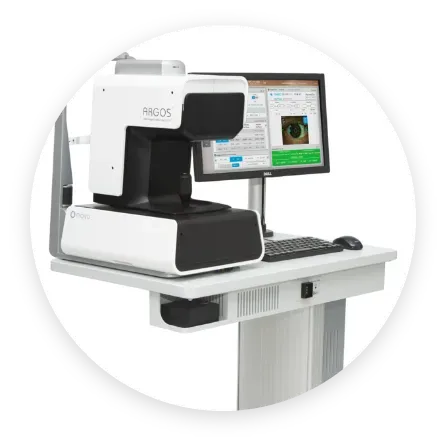
An optical biometer that precisely measures axial length and corneal curvature before cataract and presbyopia surgery to calculate intraocular lens power, supporting accurate lens selection.
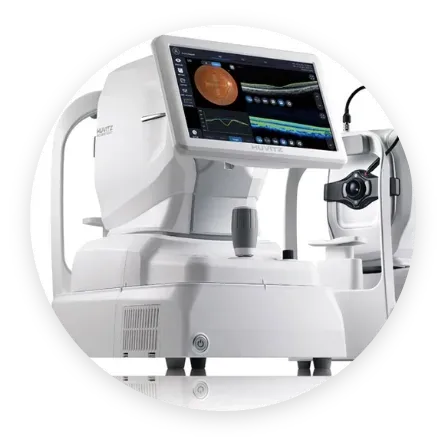
An optical coherence tomography device that captures cross-sections of the retina and optic nerve without contact, supporting early detection of glaucoma and retinal disease.
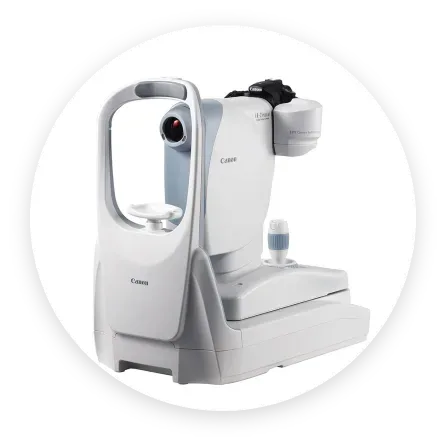
A Canon diagnostic imaging unit that photographs the retina and optic nerve at the back of the eye, used for comprehensive eye-health assessment.
Expected Results
- An easy grasp of how presbyopia and cataract differ
- Helps gauge what stage your symptoms may be at
- Supports clearer communication during exams and consultations
- Helps you appreciate the value of early checks
Frequently Asked Questions
They differ. Presbyopia is the lens losing focusing power so near objects blur; cataract is the lens clouding so vision turns hazy. They often appear together.
Directions
6F, 17 Seocho-daero 77-gil, Seocho-gu, Seoul (BLOCK77)
Incheon Airport → Seoul Station (Express Train, ~43 min) → transfer to Line 2 or Sinbundang Line → Gangnam Station
Incheon Airport → bus toward Gangnam/Yeoksam (travel time varies with traffic)
Varies with traffic; can take longer during peak hours
※ Actual travel time varies with traffic and departure schedule; for reference only.