
LASIK in Korea: All-Laser LASIK
Blade-free, no-touch all-laser LASIK. ClearSeoul Eye Clinic offers lasik in korea, a 2-minute walk from Gangnam Station, with English-speaking medical coordinators throughout and the same price for international and Korean patients — no hidden markups. We help plan your pre-op exam and trip, if you want to know the cost of vision correction in Korea and read reviews from international patients. Book a one-on-one consultation today.
LASIK in Korea: Choosing All-Laser LASIK
- Overview: Blade-free, no-touch all-laser LASIK
- Pricing: Among LASIK in Korea options, All-Laser LASIK's published starting price is KRW 2,090,000+, the same for international and Korean patients.
- Length of Stay: We recommend planning a 2-day/1-night trip (including a next-morning post-op check).
- Interpreter: English and Chinese medical interpreters are with you throughout — from the pre-op exam and consultation to surgery and post-op follow-up, professional staff help you communicate every step of the way.
Why Choose LASIK in Korea?
When choosing where to have LASIK in Korea, it's worth first confirming the surgeon's experience and credentials, whether full language support is available, and whether the pre-op exam is thorough. Procedures at ClearSeoul Eye Clinic are performed by Director Lim Tae-hyung, a Seoul National University College of Medicine graduate with 20,000+ vision correction procedures and a full member of the Korean Ophthalmological Society (KOS), the American Society of Cataract and Refractive Surgery (ASCRS), and the European Society of Cataract and Refractive Surgeons (ESCRS). The pre-op exam, consultation, and All-Laser LASIK procedure can all be completed the same day, with English and Chinese medical interpreters on hand throughout — and international patients pay the exact same price as Korean patients, with zero hidden markups, so you can plan your whole trip with confidence.
Procedure Overview
ClearSeoul All-Laser LASIK creates the corneal flap using a laser alone, without a blade (microkeratome). Unlike standard LASIK, which uses a blade, it uses the laser from the flap-creation stage with the goal of producing a more precise and uniform flap. With standard LASIK, the corneal flap is roughly 130–160㎛ thick, uneven in thickness, and made only to a fixed thickness and diameter. All-Laser LASIK, by contrast, can create a thin and highly uniform flap of about 90–110㎛, and the flap size can be controlled in an individually customized way. Concerns that can relatively occur with the blade method, such as nighttime glare or dry eye, are also reported to be comparatively less. Because the cornea can be handled more thinly and uniformly, you can expect precise correction tailored to each person's corneal condition. As suitability depends on corneal thickness and the degree of vision error, we recommend confirming whether this approach fits you through a detailed examination and specialist consultation.
All-Laser LASIK — Clinic & Equipment
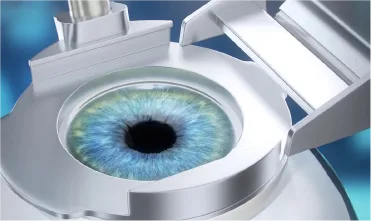
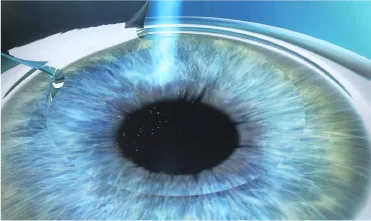
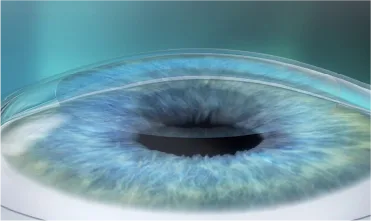
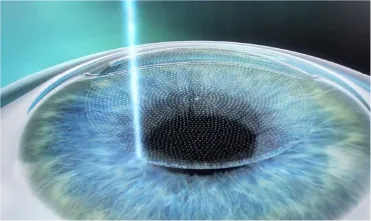
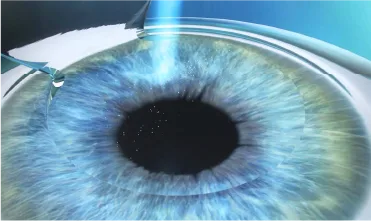
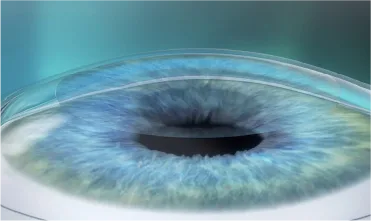
It's an all-laser approach that balances precision with a steady recovery pace.
But you also care about safety, how fast you'll recover, night-time visual quality, and whether daily life will be interrupted.
From flap creation to vision correction, every step is done with lasers — reducing variables introduced by a blade and making the process more precise and stable.
A two-stage process for a more precise vision correction design: 01 the Z8 femtosecond laser creates the corneal flap, then 02 the EX500 excimer laser performs the correction.
The femtosecond laser creates the corneal flap — with real-time OCT-assisted reading, low-energy precision cutting, and a fine beam of 2μm or less.
As a two-stage approach within Korean laser eye surgery, All-Laser LASIK completes correction using the Z8 femtosecond laser and the EX500 excimer laser: 01 Z8 replaces the blade with a laser to create the corneal flap, then 02 EX500 performs the laser correction — with no blade involved at any stage. This design addresses the concerns most patients weigh together: safety, recovery speed, night-time visual quality, and whether daily life gets interrupted.
The excimer laser performs the correction — with fast, stable scanning, real-time eye tracking, and finer corneal sculpting.
The key to All-Laser LASIK is the seamless handoff between the 'corneal flap' step and the 'laser correction' step. Z8 and EX500 each bring their expertise to a different stage — and only when the two work in precise coordination can the result achieve flap uniformity, corneal surface smoothness, fine visual quality, and customized control.
The two handle the cornea differently. LASIK creates a corneal flap, lifts it, corrects with the laser, then repositions it. LASEK doesn't create a flap — it gently lifts only the corneal surface epithelium, corrects, then lays it back down. Recovery pace also differs: LASIK vision improves relatively quickly, with most patients seeing a clear improvement by the next day, while LASEK recovery is slower, typically stabilizing gradually over days to weeks. Early discomfort differs too — LASIK causes less disruption to nerves beneath the flap, so early discomfort tends to be mild, while with LASEK the epithelial layer needs to reattach and heal, so early on there may be more noticeable foreign-body sensation, stinging, or tearing, which is a normal part of healing. Which approach suits you depends on your individual eye condition.
Not everyone is suited to the same approach. Before surgery, corneal thickness, pupil condition, and higher- and lower-order aberrations are examined, along with an overall eye assessment.
The Z8 femtosecond laser creates the corneal flap with real-time OCT-assisted reading, low-energy precision cutting, and a fine beam of 2μm or less, while the EX500 excimer laser sculpts the cornea with fast, stable scanning and real-time eye tracking. Working in precise coordination, the two devices set all-laser LASIK apart from blade-based standard LASIK across flap uniformity, the degree of customized control, and considerations around night vision and dry eye.
The result is a more even thickness and a smoother cut surface.
The cornea is finely sculpted according to each patient's refractive condition, with real-time tracking of eye position.
Vision gradually settles, allowing recovery to follow a more natural pace.
The pre-op exam covers four areas — corneal thickness, pupil condition, higher- and lower-order aberrations, and an overall eye assessment — with readings precise down to figures like 561μm corneal thickness, a 6.23–7.12mm pupil diameter range, and 0.32μm total higher-order aberration. LASIK also causes less disruption to nerves beneath the flap, so most patients see a clear improvement by the next day and recover faster than with LASEK, making it especially suited to those who prioritize recovery speed and visual quality or who are sensitive to glare or have larger pupils.
Regular follow-up visits and lifestyle guidance help keep vision more stable.
Standard LASIK vs ClearSeoul All-Laser LASIK
Who It's For
Treatment Process
Equipment Used
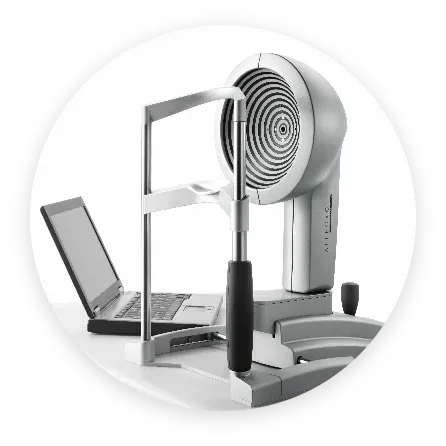
A corneal topographer that precisely measures the curvature of the corneal surface to detect astigmatism and corneal irregularities, providing baseline data for vision-correction planning.
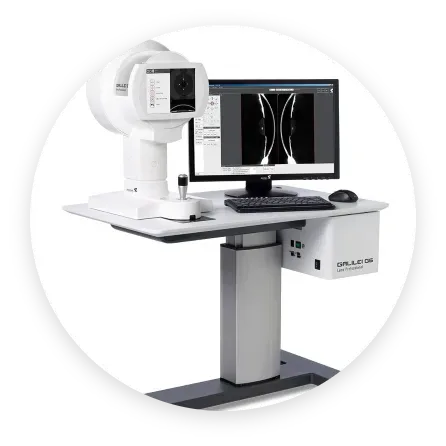
A corneal tomography and topography analyzer that maps the front and back surfaces and thickness of the cornea in 3D, helping assess suitability for vision correction surgery.
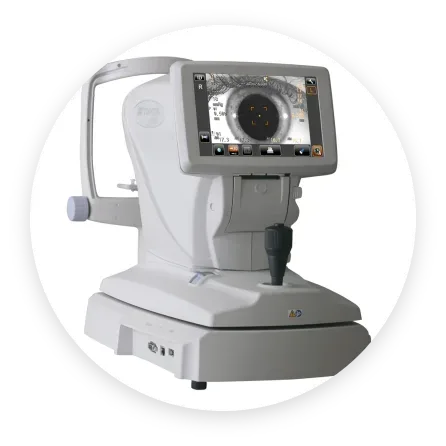
An automated device that quickly measures refractive errors — myopia, hyperopia, astigmatism — and corneal curvature, forming the basis for accurate prescription assessment.
Expected Results
- Creates a thin, highly uniform flap of about 90–110㎛
- Flap size can be controlled in a customized way
- May ease nighttime glare and dryness compared with the blade method
Frequently Asked Questions
Regular LASIK may use a fine blade to make the flap, whereas all-laser LASIK creates the flap and corrects vision entirely with lasers — blade-free and no-touch.
Directions
6F, 17 Seocho-daero 77-gil, Seocho-gu, Seoul (BLOCK77)
Incheon Airport → Seoul Station (Express Train, ~43 min) → transfer to Line 2 or Sinbundang Line → Gangnam Station
Incheon Airport → bus toward Gangnam/Yeoksam (travel time varies with traffic)
Varies with traffic; can take longer during peak hours
※ Actual travel time varies with traffic and departure schedule; for reference only.